
Navigating Information Overload
Finding valuable content in the endless digital storm of information

I pretty much live on the internet. Some of it's because of work, but a big chunk of my time online is just because I love it. Even ten years back, my parents used to be concerned on how glued I was to my digital screens. So much so that they had to enforced quotas on how much time I was reading physical books per week. Truth is, while a lot of my time today is spent on my laptop or phone, the majority of my time is not spent binge-watching Mr. Beast on YouTube or scrolling infinitely on TikTok. Instead, my time is spent finding interesting articles to read, tuning into podcasts for insights, and understanding new concepts by exploring the web.
Where did the Internet go wrong?
Since its inception, the internet has served as a platform for sharing research, knowledge, and diverse perspectives in our world. Initially comprised of personal websites, blogs, and discussion forums, it offered access to a vast repository of information at no cost.
However, the reality of information sharing in today's world is far from ideal. Instead of realizing the true vision of information exchange envisioned by pioneers like Tim Berners-Lee we find ourselves navigating through cluttered platforms inundated with advertisements and self-promotion tactics. This inundation makes it increasingly challenging to focus on specific topics and sift through the noise to discover the most valuable insights from across the web, for a multitude of reasons, two of which I will explore here.
One significant reason is that a considerable portion of the information we consume comes from social media feeds. These platforms are designed to deliver an infinite barrage of varied information, aiming to be addictive and often polarizing. They provide an overwhelming abundance of information, often more than we can handle. On average, we are spending over 1300 hours on social media each year - that’s almost 2 months straight! This flood of content prompts many of us, myself included, to resort to opening links in private tabs to avoid influencing the content these platforms show us. Despite the staggering statistics, these platforms continue to draw us in. They tailor content to our preferences, but not necessarily in the way we might expect. Instead, their primary aim is to maximize ad revenue by capturing and holding our attention - something they do exceptionally well.
Nevertheless, there are benefits to these platforms. They offer us insights into the thoughts and opinions of our friends and trusted sources online, which can be incredibly valuable. This allows us to stay updated on the latest news, engage in discussions, and find solutions to the challenges we encounter.
Playing defense
Another significant factor contributing to information overload is search engine optimization (SEO) and companies “playing the algorithm”. Initially intended to streamline information retrieval, search engine results now prominently display content based on advertising budgets and the effectiveness of promotional articles to push their brand. For example, if I search up “How to use AI in my business?”, instead of getting an expert’s opinion like Andrej Karpathy or Geoffrey Hinton, I am served three ads. Even below these ads, the following links are companies that are looking to promote their brand or product. While personal blogs and opinion pieces often harbor valuable information, they are increasingly challenging to unearth due to these algorithms. Personally, I stumble upon such valuable resources by sheer chance, typically through someone's Twitter feed or cross-referenced in other articles.
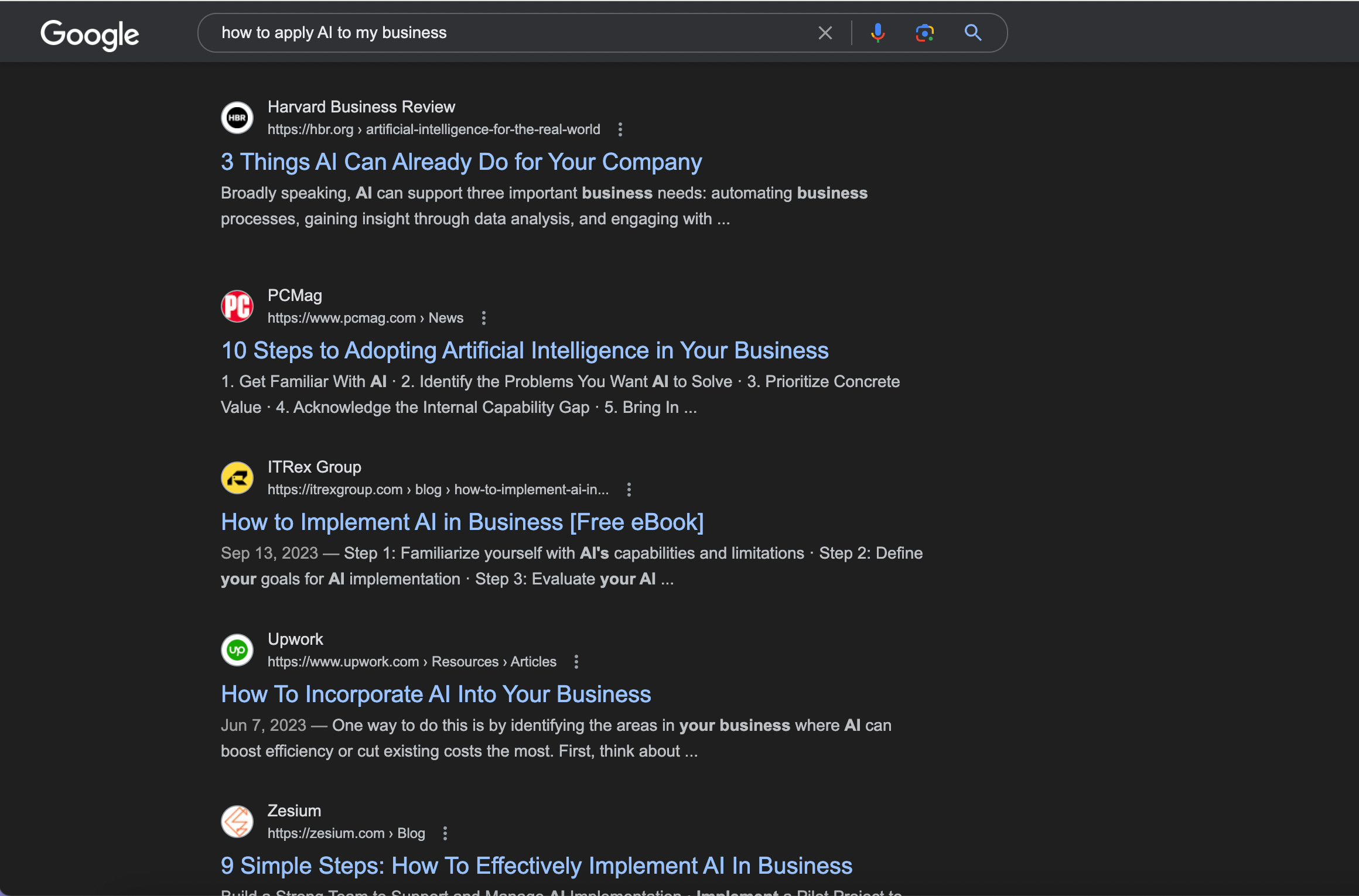
The way I see it - we are on the defensive. With extreme information overload, we have to sift through the noise on social media platforms and search engines to to discover content relevant to our interests or problem-solving needs. A lot of our brain power goes to having our guards up to defend what is most important to us - our time. Let’s flip the script and go on the offensive. How can we get out of the mess that is filled with SEO-driven content, influencer endorsements, and incessant ads?
Let’s be clear, I’m not talking about shutting off the information tap altogether. Knowledge is power and we want to continue to learn - just on our own terms. The question is rather: How do we get rid of the noise of self-promotion, marketing and growth hacking?
Say hello to Commonplace
Enter Commonplace, a platform designed for you and your trusted circles to effortlessly share content with each other and the wider web. Knowledge communities are incredible hubs for sharing and discovering information, and they come in all shapes and sizes, from Discord servers to iMessage group chats with like-minded individuals, even book clubs. But there’s a hitch—they're scattered across various platforms and conversations, making it a challenge to keep track of and filter through, and the platforms are not designed for this use case.
With the Commonplace app, sharing information is as simple as highlighting a quote or saving an article, all within one convenient space. Imagine consolidating all your favourite content in one spot and effortlessly sharing your thoughts with friends directly through the content to drive conversation.
The aim of the platform is to return to the essence of the internet—sharing information that you find intriguing or worthwhile with others, but without the distractions of ads and algorithms that consume your attention and exacerbate information overload. On Commonplace, content is surfaced based on what your friends are reading, what you've already explored, and the problems you're keen on solving. This stands in contrast to the typical approach driven by SEO for brand visibility and ad revenue
We've been hard at work crafting the perfect solution for our needs, and now we're slowly opening the doors for you. Come and be the first to explore an internet tailored to you and your friends by signing up for our beta at mycommon.place. We can't wait to welcome you aboard soon!